
From diesel to direct current: Powering the electrification of commercial vehicles with megawatt charging
 The world has never been more connected. Goods and people are moving further and faster than ever before, with no end in sight. Passenger transport and global freight demand are each expected to triple until 2050, according to projections of the International Transport Forum at the OECD.[1] The environmental toll of transport, however, is significant: Heavy-duty vehicles (HDV) account for more than a quarter of greenhouse gas emissions (GHG) from road transport in the European Union alone and for over 6% of total EU GHG emissions, for instance.[2] Electrification of commercial vehicles coupled with advances in megawatt charging promise a way out.
The state of electrification for heavy-duty commercial vehicles
When it comes to electrification, not all heavy-duty commercial vehicles are created equal. Buses, and city buses in particular, have become electric much faster, thanks to their relatively fixed routes, lower travel distances and ability to depot-charge. Sales of electric buses are far ahead of other heavy-duty vehicle segments in all geographies. In the European Union, battery-electric vehicles reached a 43% share among city buses in 2023.[3] The same trend is applicable to light electric commercial trucks that are mainly used within cities, i.e. in zero emissions or “green” zones for freight.
However, when it comes to heavy-duty vehicles, diesel trucks still made up for more than 95% of sales in the EU in 2021.[4] Electric truck sales increased almost threefold in 2023 in Europe, but still accounted for less than 2% of total sales. In the United States, the number tripled as well but accounted for a mere 0.1% of total truck sales. The notable exception is China, which accounted for 70% of global electric truck sales.[5]
On a global level, sales of battery-electric HDVs for the first time surpassed the sales level of electric buses. This indicates that electrification of HDVs is accelerating, largely because of technological advancements in e-truck and charging technology as well as more ambitious CO2-reduction targets for the sector in several geographies. In the EU, regulation now sets the path for truck OEMs to reduce their new fleet emissions by up to 45% by 2030 and by at least 90% by 2040.
Key enabler, key bottleneck: Charging
According to a prognosis by PwC, more than 20% of transportation will be electrified by 2030 – driven by the diffusion of heavy-duty vehicles and urban buses.[6] But how will this steep growth come about in only a few years? Largely because battery-electric powertrains could achieve total cost of ownership parity in many heavy-duty vehicle applications this decade, including long-haul trucks: “Even for the very challenging long-haul cross-border truck applications, battery electric technology can provide the most cost-effective solution before 2030, assuming the availability of a high-power MW public charging infrastructure in Europe.”[7]
In an industry where time equals money, megawatt charging is a key enabler for the electrification of heavy-duty transport. Imagine a highway rest stop where electric, emission-free heavy-duty trucks pull in silently not for a 70-minute recharge that is common today even with DC fast-charging (e.g. 350 kWh), but for a swift 15-20 minute “pump-and-go” refueling, akin to diesel stops today. This is the promise of megawatt charging. Yet, achieving such “diesel-like” turnaround and uptime for electric commercial fleets hinges on overcoming formidable technical and infrastructure challenges.
Many of the infrastructure challenges yet to be overcome require close cooperation of policymakers, grid operators, charging manufacturers and logistic fleet operators – including the limited availability of megawatt chargers along public corridors, investment in grid-connected high-power hubs, grid limitations and power availability at highways rest stops, investments in depot charging infrastructure, managing more route planning complexity, and more.
Gearing up for the megawatt charging standards (MCS) levels 2 and 3, however, also poses fundamental challenges for the electromechanical components used in batteries and chargers to safeguard performance, safety and system reliability. While MCS level 2 targets up to 1.5 MW (1.500 A at up to 1,000V), MCS level 3 aims for up to 3 MW or more with voltage up to 3,000 A. This power boost drastically reduces recharging times even for large battery packs. In essence, MCS level 3 will provide the industrial-grade readiness that will scale the electrification of heavy freight transport on highways, not just in more controlled and predictable depot environments. If charging standards, grid updates, and the vehicle-side technology align, level 3 charging could roll out commercially before the end of this decade.
Against the backdrop of global climate targets, particularly the EU’s commitment to reduce emissions by at least 55% by 2030 and reaching climate neutrality by 2050, megawatt charging isn’t just about convenience—it’s necessity. To meet the -1.5°C goal, the rapid decarbonization of freight transport must accelerate now. That means megawatt charging must advance as a present-day requirement, and not a future ambition. Charging and vehicle manufacturers need to urgently align their roadmaps and begin planning their next-generation products around MCS level 2 and 3 standards to meet the pressing climate and regulatory timelines.
How to overcome thermal challenges in megawatt charging
Because of the extremely high currents at play with MCS levels 2 and 3, thermal management is one of the most critical hurdles that can threaten performance, reliability and safety of freight, vehicle and driver. The higher the current, the faster the charge, but also the more heat is generated when electricity is sent through cables, connectors, contactors and into the battery. At megawatt charging levels, between 1,000 to 3,000 A are pushed, which is 30 to 50 times more than what a typical home EV charger delivers.
Heat is the main byproduct of high-speed charging, and if it’s not carefully managed, it poses safety risks since overheated components can melt, short-circuit, or even catch fire. Components also wear out faster when exposed to high heat. And, most importantly, batteries degrade much faster when they are repeatedly charged under hot conditions, which reduces range, lifespan and the residual value of e-trucks, thus putting their TCO at disadvantage with conventional diesel-powered trucks.
Even if heat is managed with liquid cooling that takes away the heat in high-current applications, it still takes a heavy toll on TCO: Power losses grow quadratically with current. Hence, a significant portion of energy needed for the powertrain or the battery evaporates as heat and may necessitate additional cooling which comes with a price tag as well. At the contactor level, it is therefore imperative to minimize contact resistance in high-current applications in order to maintain an efficient energy transfer and to ensure competitive total costs of ownership.
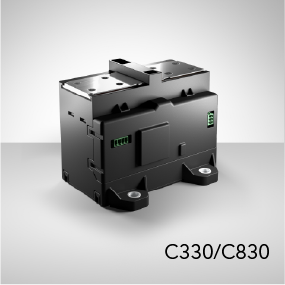 Schaltbau has already introduced a new series of bi-directional contactors designed for stationery and mobile megawatt charging at level 2 and level 3. Its flagship solution C330 reduces contact resistance to as low as 40 µOhm, ensuring best-in-class performance with low contact warming. In contrast, average DC contactors on the market register power losses of over 200 µOhm (equaling a power/heat loss of 450W at 1,500 A).
With two main circuits – one for making and breaking, one for carrying the current to ensure maximum contact protection – the C330 also ensures stable contact resistance and the same thermal performance over long periods of operation. The megawatt charging contactor series reduces power losses in the system, delivering up to 25% of energy cost savings and avoiding the costs associated with extra cooling.
To electrify heavy-duty fleets at scale, OEMs and fleet operators need more than powerful batteries and fast chargers—they need highly efficient, thermally robust, and future-ready components. Megawatt charging is not just a technological advancement; it’s a strategic imperative for achieving climate goals and maintaining competitiveness. The transition to zero-emission transport hinges on infrastructure and vehicle readiness, and both must accelerate now. With smart thermal management and robust components, the path toward sustainable commercial transport is not only viable, but inevitable.
References
[1] International Transport Forum, ITF Transport Outlook 2019.
[2] European Commission, Reducing CO₂ emissions from heavy-duty vehicles, 2023.
[3] International Energy Agency, Trends in heavy electric vehicles – Global EV Outlook 2024.
[4] Basma, Hussein; Rodríguez, Felipe, A total cost of ownership comparison of truck decarbonization pathways in Europe, International Council on Clean Transportation Working Paper 2023-28, November 2023.
[5] International Energy Agency, Trends in heavy electric vehicles – Global EV Outlook 2024.
[6] PwC, Truck Study 2024. The diversification of battery-electric truck platforms will shape the next phase of the eMobility revolution, September 2024.
[7] Basma, Hussein; Rodríguez, Felipe, A total cost of ownership comparison of truck decarbonization pathways in Europe, International Council on Clean Transportation Working Paper 2023-28, November 2023, p. 19