
Powering up for net zero: the importance of direct current in energy storage
How do we tackle climate change? Phasing out fossil fuels and increasing the share of renewable energy might come to mind. Indeed, fossil fuels currently account for over 80% of the global energy mix. This figure must fall to almost 10% by 2050 to reach net zero.1 Yet, while the share of renewables needs to increase, the baseline demand for energy is increasing as well.
As digitization, automation and electrification increase and populations grow and become more affluent, demand for energy is growing across many countries in the world. According to Statista, global electricity demand is projected to double by 2050 relative to 2020 levels,2 which makes the challenge of transitioning to renewables even more challenging. But not only does the share of low-carbon energy sources need to increase – storage capacity needs to surge, too.
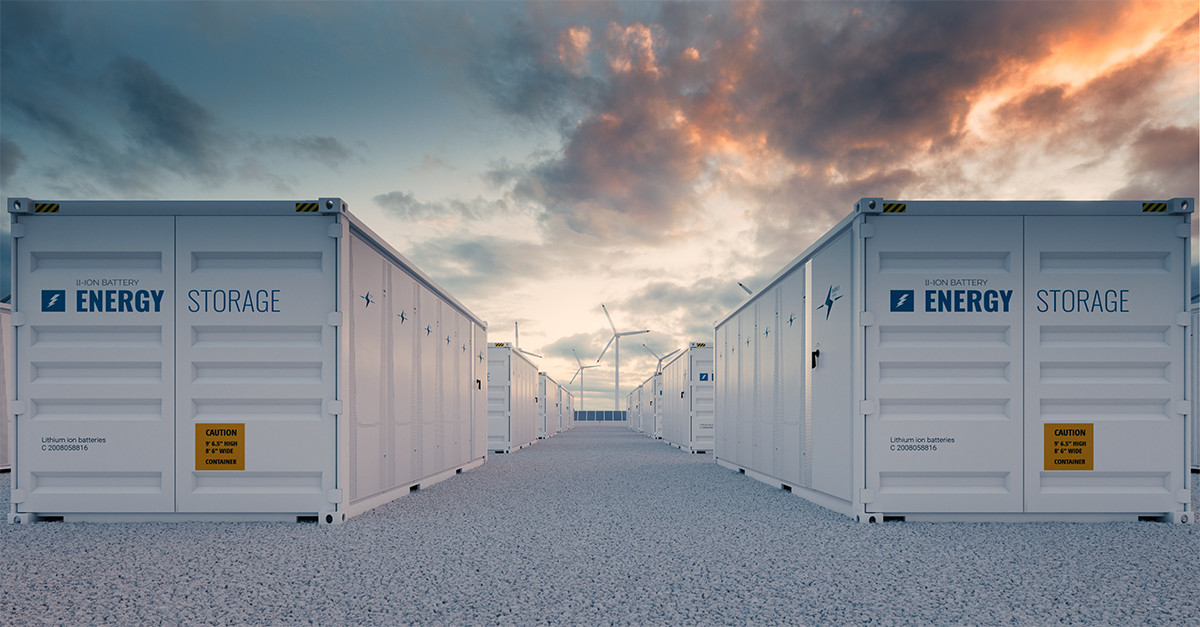
With wind and solar expected to account for the largest share of power output in the coming decades, energy storage will be critical for reducing imbalances between supply and demand. Despite their undeniable advantages, solar and wind power are intermittent resources. Wind power is uncontrollable and may generate at a time when no additional power is needed. Solar power varies with cloud cover and, if not stored, is only available during the day.
No energy transition without energy storage – and DC contactors
“Electricity storage has an important role to play in [the ramp-up of renewables], both for energy storage as such and also for the stabilization of the electricity system and the grids. Currently, a strong and market-driven ramp-up of battery storage is taking place,“ states the German Federal Ministry for Economic Affairs and Climate Action in its “Electricity Storage Strategy“ published in December 2023. Similarly, the International Energy Agency (IEA) expects global installed storage capacity to expand by 56% in the next 5 years to reach over 270 GW by 2026.3
Intelligent direct current (DC) components are a critical part of the future energy storage infrastructure. Unlike many home appliances and the power grid, which use alternate current (AC), photovoltaic panels produce and batteries store DC power. However, safe and fast switching under the DC load places high requirements on electromechanical components. In case of an emergency, contactors need to disconnect the battery unit (or in the case of utility scale applications, the battery bank) immediately from the system. With the evolution of battery energy storage systems, industry is looking for ways to further increase system efficiency, i.e. by pushing to higher DC voltages.
Schaltbau’s DC contactors play a crucial role in energy storage systems, offering several advantages that enhance their performance, safety, and efficiency.
- Safe disconnection of the battery unit: Schaltbau contactors can handle high-voltage arcs that can occur when switching DC loads. In case of maintenance or an emergency shutdown, they ensure a safe disconnection of the battery unit from the inverter in energy storage systems.
- Increased system efficiency: Due to their low contact resistance and low energy consumption, they contribute to overall efficiency of the energy transfer to and from the battery and minimize heat dissipation: to transfer the energy and not to lose it.
- Full bi-directionality: Schaltbau’s DC contactors ensure the safe disconnection of high power regardless of the current direction. They safely manage potential fault modes in both directions of current flow.
- High breaking capacity: DC contactors meet the high requirements for breaking capacity of industrial storage systems, leading to increased system availability and improved total cost of ownership (making capacity, continuous thermal current, rated short-time withstand current).
The global energy storage market is projected to grow rapidly – at a compound annual growth rate (CAGR) of around 10% within this decade. Apart from the obvious environmental advantages of integrating a higher share of renewables, there are also fundamental economic benefits for enterprises wanting to integrate renewable energy generation and on-site storage systems.
Energy storage is a smart move for business, not just the environment
Electricity purchase prices are calculated according to a formula that includes the peak loads drawn and the provision of sufficient capacity. These provision charges must be paid for the entire billing period, even though the peak load capacity might only be used for a fraction of the time. Energy storage enables energy to be saved for later use. Consequently, it allows businesses to avoid higher tariff charges, reduce operational costs and save on their electricity bills.
In addition, energy storage solutions supply energy continuously even when the network is unstable due to peaks or extreme weather events, thus reducing grid dependency. Energy storage facilities also provide back-up power in the event of an outage guaranteeing business continuity.
Energy storage will be crucial for the world to accelerate its journey towards net zero. Sophisticated industrial components, such as DC contactors, connect renewable energy sources, energy storage systems and electrical consumers without the energy losses that occur when direct current is converted to alternate current. In the quest for carbon-neutrality, the paradigm shifts toward renewable energy generation and advanced energy storage systems, creating the energy solutions for a better tomorrow – and Schaltbau is there every step of the way.
Read more about Schaltbau contactors and Eddicy energy storage solutions here.
References:
- International Energy Agency. (2021). Net zero by 2050: A roadmap for the global energy sector. International Energy Agency.
- Statista. (n.d.). Energy storage. Retrieved June 12, 2024, from https://www.statista.com/topics/4632/energy-storage/#topicOverview
- European Commission. (n.d.). Recommendations on energy storage. Retrieved June 12, 2024, from https://energy.ec.europa.eu/topics/research-and-technology/energy-storage/recommendations-energy-storage_en