
Schaltbau’s NExT Factory: Lessons from the world’s first DC microgrid-powered plant
CEO Helmut Pusch reflects on DC microgrids in practice, the challenges of pioneering sustainable production, and what it means for the All Electric Society
 Schaltbau has described NExT Factory not just as a milestone for the company, but for the industry. What makes it so significant in your view?
Helmut Pusch: To me, it represents a functioning model of what the future of industrial production could — and should — look like. The factory is built around a new energy logic. Instead of relying on conventional AC grids, we have implemented a DC microgrid that allows us to operate more efficiently, reduce conversion losses, and integrate renewable energy far more effectively. In doing so, it aligns perfectly with the vision of the All Electric Society – a world in which energy is generated renewably, used efficiently, and distributed intelligently across sectors. NExT Factory proves that this is not an abstract idea. It is already possible today, even in a complex manufacturing environment.
If you were to summarize the first two years in a nutshell, what would you say?
We have been able to demonstrate that it is entirely possible to run a manufacturing site powered by direct current. That in itself is a pioneering achievement, and I commend the entire team for turning this vision into reality. NExT Factory is a testament not only to Schaltbau’s engineering excellence, but also to the unwavering grit and perseverance in working with authorities and grid operators.
No stumbling blocks?
Of course, we faced some initial challenges, including fine tuning the interaction between our DC grid and the public AC grid, and adjusting automation processes to run smoothly in a DC environment. But we addressed them by working closely with our technology partners, investing in employee training, and making incremental improvements. Within a short time, we were able to stabilize operations and ensure seamless production.
 Let’s talk numbers: What were your initial energy saving targets for NExT Factory and have those been achieved?
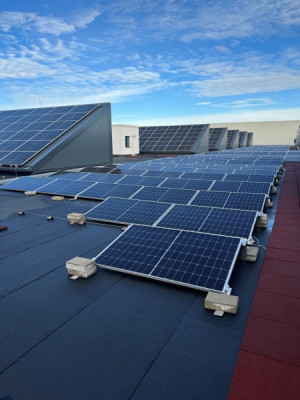
When NExT Factory began operations, our goal was to save up to 15% in energy annually with our direct current (DC) microgrid. The photovoltaic system on the factory roof generates around 1.3 MWp of energy per year which is directly fed into the DC microgrid without being converted into alternating current, as is typically the case. In practice, we have exceeded this target: thanks to reduced conversion losses and higher system efficiency, our PV systems deliver an 8% efficiency boost compared to AC, and DC-coupled battery systems avoid a further 3–4% in energy losses.
In addition, we have set up the factory to function like a kind of circular economy for energy. By implementing the DC grid alongside intelligent energy management and storage, we targeted a 35% annual reduction in energy costs — and this is exactly what we are achieving today. Our average annual self-sufficiency rate currently stands at around 66%, based on renewable electricity sourced and consumed on site.
You mentioned the vision of the „All Electric Society” earlier. In what way is the factory exemplary to it?
First of all, the All Electric Society envisions a shift away from fossil fuels, with energy supplied primarily from renewable sources. In line with that, we operate a fully electrified production facility with minimal CO2 emissions. The second key principle is increasing energy efficiency and achieving energy savings. We significantly reduce AC/DC conversion losses and manage energy far more intelligently to maximize self-consumption, for instance, by directly reusing recuperation energy in our logistics warehouse system, which has reduced peak loads by up to 85%. We also saved 25% in materials during construction, such as copper, because higher voltages in DC allow for significantly smaller cable cross-sections. And thirdly, I believe that NExT factory shows that sector coupling is possible on a factory scale.
 What do you mean by that?
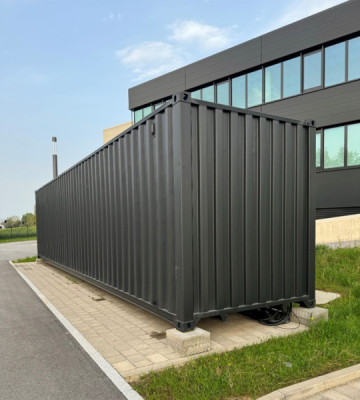
In the context of the “All Electric Society”, sector coupling refers to the integration and coordination of different energy sectors, such as electricity, heating, transportation, and industry, so they can exchange energy and make more efficient use of available resources. At the NExT Factory, these sectors do not operate in isolation but are interconnected. We generate electricity from solar power. We store excess power not only in our DC battery storage system, but also in heat – the factory has a thermal storage capacity of 10 MWh. The factory’s DC grid also supplies power to the charging infrastructure for electric vehicles, forklifts and electric industrial trucks. In other words, we are maximizing the use of renewable energy by linking it directly to our various energy demands.
What’s next for the NExT Factory?
NExT Factory sets a benchmark and serves as a scalable model for sustainable manufacturing. We hope to see broader adoption of similar DC microgrid systems — more “NExT Factories” — which could significantly reduce CO2 emissions across the sector and help advance the vision of the All Electric Society. Since our opening, we have welcomed more than 20 international visitor groups from across the globe, including many industry peers. I am confident we will see growing interest in and adoption of DC technology in industrial production environments – and we are happy to support these initiatives by sharing our experience, consulting on projects, and supporting others with our pioneering AI-driven EMS solution or our contactor and smart circuit breaker portfolio.
Learn more about the NExT factory, DC microgrids and intelligent EMS here.