
Mastering high-voltage testing: How Eddicy contactors elevate test bench safety and performance
 From an early age, we learn the importance of making informed decisions, whether as private consumers or when making B2B decisions in our professional lives. Whether we prefer customer testimonials, independent test research, certification or product reviews, we all want to be sure that what we see is what we get.
Suppliers are responsible (and liable) for their products. Particularly in industries where failures can have severe consequences, the rigorous testing of products is not only a technical necessity but a legal requirement to ensure compliance with safety and quality regulations.
The global push for electrification and the increase in moving and stationary battery systems is transforming entire industries, from automotive to energy and industrial automation. As companies innovate and develop new electrified solutions, rigorous testing both in development test benches and end-of-line testing becomes critical in ensuring performance, safety, reliability and regulatory compliance.
The role of test benches in electrification
High voltages, high frequencies, thermal management under challenging current profiles, and possible failure behavior evaluation – all part of the unique engineering challenges electrification introduces – necessitate precise validation and testing of electrical components, power electronics, and entire systems under real-world conditions before deployment. Hence, engineers require adaptable, modular set-ups capable of handling increasing power levels: With electric vehicles and grid storage systems operating at voltages up to 1,500V and above and currents in the kiloampere range, test benches must handle extreme conditions safely.
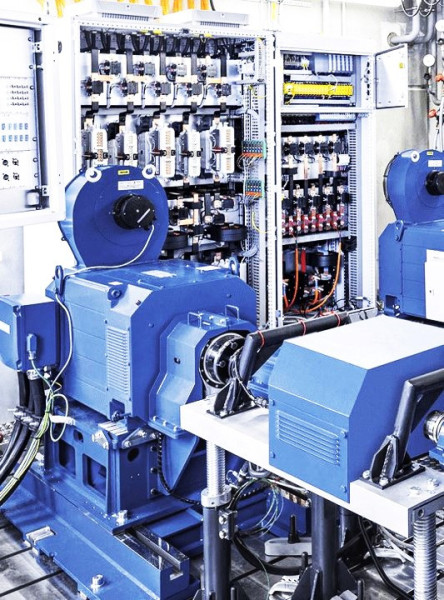
Test benches, systems to test the function and defined parameters of a device under test (DUT), require powerful contactors and relays to connect the different measurement instruments, power supplies and loads as well as to switch-off of the complete system in case of an emergency. For e-mobility, battery and many other energy applications, the challenge lies in safe extinguishing of the arc, insulation breakdown, and reliably withstanding thermal currents and short circuit currents during high-power testing.
What makes a test bench contactor different?
So, why would your everyday contactor not do it in a test bench to ensure safe power handling? Because they need to follow extraordinary safety standards and have a number of special requirements. Firstly, test equipment needs to be very robust since it is typically difficult to maintain. Understandably, customers prefer electromechanical components that they install once and then never have to think about again. High short-circuit withstand capacity to avoid “stuck-on” contactors with welded contacts is mandatory as well as a mirror contact feedback according to IEC 60947-4-1. Contactors should be ready to serve a wide current range as well as voltages sometimes than it’s typical in “classic” industry applications. And, above all, test bench contactors need to ensure reliable control of the test samples as well as the safety of the operating personnel and the long-term availability of the test system itself in the event of a fault.
Schaltbau customers rely on our wide range of contactors for a variety of energy and e-mobility applications. Key features of those contactors include their very low contact resistance, leading to low heat dissipation and high thermal currents, excellent isolation voltage up to 4,800 V as well as auxiliary contacts with normally-open and normally-closed functionality or mirror contacts functionality for a safe feedback loop according to IEC 60947-4-1, Annex F. In addition, their high bi-directional current interruption capability makes them particularly suited to evaluate both charging and discharging cycles or energy simulations with connection to a grid. Their non-encapsulated arc chambers provide for a robust design, their sturdy contact-tips makes the probability of the contacts welding low.
Safe and reliable switching for test benches with Eddicy
Our portfolio of Eddicy contactors is designed to deliver exceptional performance and safety across a wide range of applications in e-mobility and energy testing. With a variety of series, such as the CP, 320, 310, 300, C303 and more, we provide versatile solutions to meet both standard and highly specialized requirements.
From high currents to high voltages, our contactors are engineered to handle everything from 10 to 2000A and 24V to 3000V, covering both AC and DC loads. Each series is built with robust features to ensure long-lasting reliability, high efficiency, and exceptional performance even under the most demanding conditions. Our products can be customized to fit any need, whether it's for specialized testing, custom solutions for extra-high voltages, or even addressing unique safety and mechanical challenges. No request is too complex or "off-the-wall" for us.
Learn more about our solutions and how we can support your electrification goals here.