
From diesel to DC: The rise of electrified farming equipment

Tasked with feeding a growing global population, farmers are among those most directly affected by the consequences of climate change. At the same time, agricultural processes such as crop and livestock production account for around 11 percent of global greenhouse gas emissions.1 According to McKinsey, “To remain on a 1.5° pathway, agriculture will have to cut its overall emissions from 14.4 metric gigatons (Gt) of CO₂ equivalent (CO₂e) to 3.1 GtCO₂e by 2050 — almost 80%.”2 Electrification and smart farming technologies offer farmers a practical path forward, helping them maintain yields while reducing energy costs and lowering their carbon footprint.
Achieving this pathway in agriculture, however, will require action across the entire value chain, including reducing food loss and waste and encouraging dietary shifts.3 When it comes to measures that directly support on-farm decarbonization, the electrification of agricultural machinery powered by renewable energy ranks third among the 28 measures identified in McKinsey’s “The agricultural transition: Building a sustainable future” report.4 Electrified tractors or solar-powered irrigation systems are therefore important elements in the transition toward more sustainable agriculture. But they depend on advanced electromechanical components that can deliver reliable performance under harsh field conditions.
Electrifying farming equipment: Opportunities and challenges
While the electrification of agricultural machinery is still in its infancy, electric yard loaders, vineyard tractors, and farm tractors already deliver strong performance in areas where low noise levels or emission-free operation are essential. The trend toward further electrification of heavier tractors and trucks is also continuing unabated. Many countries have introduced tighter CO₂ and NOₓ limits for non-road mobile machinery, and advances in battery energy density, high-voltage DC architectures, and power electronics are making electric equipment more viable.
Despite the higher purchase price of battery-electric machinery, which still poses a barrier to broader adoption, these vehicles offer significant operational advantages. Their electric drivetrains contain fewer moving parts, resulting in lower maintenance requirements compared with diesel-powered equipment, particularly when it comes to servicing oil, filters, and exhaust treatment systems. Electric drives also deliver instant torque, reduced noise and vibration, and seamless compatibility with autonomous systems and robotics, making them ideal for smart and precision farming applications.
Electric tractors are also more efficient than diesel-powered tractors, whose engines suffer from poor fuel efficiency when idling or operating below optimal RPM levels. This efficiency advantage becomes even more pronounced when electric tractors are powered by solar or wind energy. The well-to-wheels (WTW) efficiency of a combustion engine tractor reaches only between 25 to 37%, whereas an electric tractor reaches in-between 39 and 67% when fed from wind and solar farms or between 42 and 72% when using on-farm rooftop PV systems where no conversion losses occur. As Gade et al. note, “The (diesel) engine wastes 75% of its energy and generates noise as an undesirable result. [An electric motor] has near-perfect energy efficiency and can regenerate energy while braking.”5 Nevertheless, electric tractors require larger batteries to achieve a respectable range, and their electric powertrains still come with a higher upfront purchase price.
High-power electromechanical components in agricultural applications
What sets electric vehicles, machinery, and charging systems in farming environments apart from on-road e-mobility are the extreme conditions components must withstand: dust, vibration, voltage spikes, temperature fluctuations, and high humidity all come into play Electrified machinery therefore requires rugged, long-life switching and interconnection solutions, along with effective inrush-current management and arc suppression in DC systems. Reliable contactors and connectors help minimize unplanned downtime and ensure safety in high-voltage applications. While Eddicy contactors from Schaltbau switch the load circuit on and disconnect it safely, the robust Eddicy connectors ensure secure, long-lasting connections even under severe exposure to dust, moisture, vibration, and temperature extremes.
In a battery-electric tractor, connectors form the critical interface that safely links the high-voltage battery pack to inverters, motors, and auxiliary systems. By maintaining low-resistance, stable electrical contact over thousands of mating cycles, they support modular system design, long-term reliability, and maximum machine uptime. When charging electrified agricultural machinery, the connector becomes the key interface between the vehicle and the charging infrastructure. A charging connector provides secure mechanical coupling and precise electrical contact, enabling consistent high-current flow without overheating or unnecessary energy losses. It also incorporates safety functions such as interlock circuits and communication pins, ensuring that charging can begin only once the connector is fully latched and both the charger and the vehicle have verified system readiness.
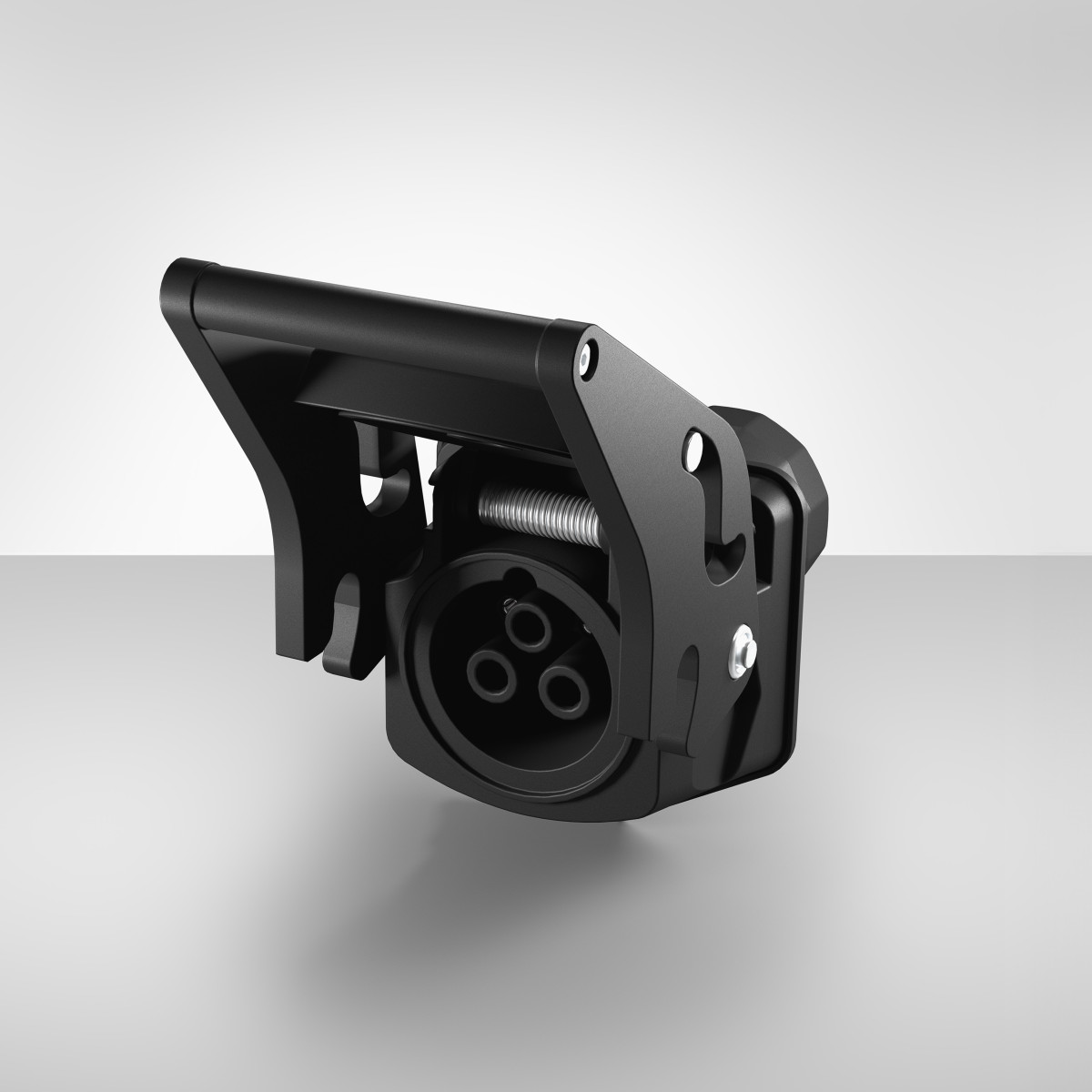
Ready to power agricultural electrification: Eddicy’s HV connectors
Eddicy HV connectors from Schaltbau provide reliable and safe power transmission up to 1,800 VDC and 470 A, enabling them to handle the high-current demands of electric tractors and large battery packs. Their low contact resistance minimizes heat buildup during long duty cycles or sustained charging. The connectors are IP69K-certified and engineered for a high number of mating cycles. Because of their robust, modular design and comprehensive protection against accidental contact, they are well-suited for equipment exposed to slurry, mud, dust, fertilizers, humidity, or high-pressure washing.
Their one-hand locking mechanism enables secure coupling even when wearing gloves or working in dirty conditions. An optional switching element in the socket housing signals when the connector is correctly plugged in. The modular arrangement of power and signal contacts also allows flexible integration on both the vehicle and charger side, for example in battery–inverter connections, battery–DC bus interfaces, onboard charging ports, or off-board charging systems.
Eddicy HV connectors combine high-current capability, IP69K environmental sealing, vibration-resistant mechanics, and integrated safety functions including insertion feedback. This makes them equally well-suited for onboard electrified tractor powertrains and for high-power charging interfaces, where reliability under harsh outdoor conditions and safe operator handling are essential.
With the advancements of agricultural electrification, new charging solutions, and renewable energy integration, such as solar-powered charging stations, the importance of safe DC switching and reliable connections for farm-wide energy management is increasing. If the 1.5° pathway is consistently followed in agriculture, local energy ecosystems in farms could eventually see renewable generation, storage and electric equipment work together.
References:
- Statista, Agriculture emissions worldwide - statistics & facts, July 7, 2025.
- McKinsey, The agricultural transition: Building a sustainable future, June 1, 2023, p. 12.
- Ibid., p. 3.
- Ibid., p. 24.
- Gade, C.R. et al., Towards sustainable farming: A state of art review on electrification of a farm tractor, in: Results in Engineering, Volume 25, March 2025, p.3.